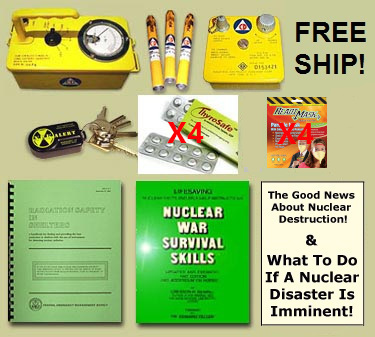
Civil Defense Radiation Detectors,
with
source to buy newly calibrated or calibrate yours! |
 |
The Good News About Nuclear Destruction!
...and then our popular & essential family guide for...
What To Do If A Nuclear Disaster Is Imminent!
...and our latest detailing protection from overseas fallout...
When An ill Wind Blows From Afar! (Like From Japan Fukushima Nuclear Crisis)
We've been promoting Nuclear Civil Defense Training of the public for well over a decade! CLICK TO ORDER KI & RAD DETECTION HERE!If you do nothing else here, read our myth-busting expose...
See where our proposal was voted & ranked #1 last year, long before Fukushima, here at...


| Last Updated: November 18th, 2023 | |
From Cold War Relics To A Calibrated First-Line of Defense!
Forward additional relevant resources or suggestions for this FAQ
to: | |
|
A:
KI4U, Inc., is the only private radiological laboratory in the nation specializing in calibrating & re-certifying all of our country's Civil Defense radiation detection survey meters and dosimeters, AND with over 100,000 instruments, and over 6 million doses of Potassium Iodide (KI), have ready for sale our largest
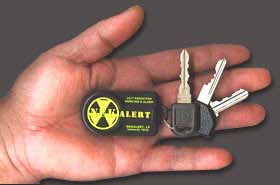
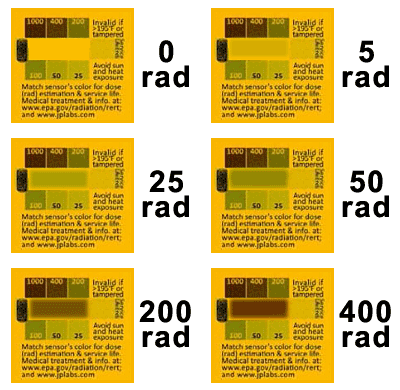
emergency stockpile of both in the nation. (Yes, we can also calibrate your surplus Civil Defense meter.) We also produce the popular NukAlert™ key-chain radiation detector & alarm and are exclusive source of the new RADSticker™ dosimeter. See them all here!
More about all that we do preparing First-Responders and fellow Americans, including FREE family nuke prep survival guides HERE! Also, See where our proposal for re-instituting national civil defense training of the public was voted & ranked #1 at DHS & FEMA National Dialogue on Preparedness.
We are the authors of the popular
Potassium Iodide (KI) Anti-Radiation Pill FAQ
and Fallout Shelters & Nuclear Civil Defense FAQ.
From the first week of having launched that original KI FAQ in 1999 we've had inquiries about, and requests
for advice on, personal radiation detectors, like the inexpensive FEMA surplus Civil Defense radiation detection survey meters, Geiger counters and dosimeters
available and for sale on the market.
Late in 2000 we began researching in earnest
the applicability and reliability of these surplus radiation detector meters for use in a nuclear emergency. As with
researching potassium iodide and its use in nuclear emergencies for the KI FAQ,
we found much fiction, misinformation, and critical omissions overwhelming the few solid facts.
(Compounding this problem was the lack of public understanding that most all the alternative
and newly manufactured radiation detecting instruments on the market are only for peace-time
use in detecting very low levels of radiation. Most will saturate out and be useless in measuring
the truly dangerous higher levels of radiation encountered in a for-real future nuclear emergency.)
We quickly discovered, though, that the most reliable sources for information about these Civil
Defense radiation detecting survey meters, geiger counters and dosimeters was from the radiological technicians who are
employed by FEMA, or under contract with FEMA, or work in state calibration labs, to maintain, repair and calibrate these
same meters.
We've also found it very instructive to have completed FEMA courses in 'Radiological
Emergency Management', as well as in 'Radiological Monitoring' where we employed these exact same
Civil Defense meters and dosimeters in practical safety exercises as we were trained how to
properly utilize them in a nuclear emergency. (We've also since completed both the
'General Employee Radiological Training' and the 'Radiation Worker Training' courses, as well as specialized training on calibration equipment.)
The initial goal throughout all of this process has been to first establish and confirm
the inherent reliability and practical applicability of these Civil Defense radiation detection survey meters
and dosimeters for use in a nuclear emergency.
We found them to be well field-proven for decades, which explained why, to this day, thousands of First-Responders nation-wide still rely upon them confidently.
In the Spring of 2001 we acquired a large
quantity (120,000+) of FEMA Civil Defense radiation detector instruments from the Federal Depot in Fort Worth, Texas. This included survey meters,
Geiger counters, dosimeters, chargers, test
equipment, and current FEMA
Repair and Maintenance Manuals. Most importantly, though, we then also hired experienced
FEMA trained technicians for our calibration lab here.
We are licensed
and authorized to perform these calibrations at our lab here in conformance with the standards as set forth
by the State of Texas, ASTM, FEMA and the NRC. We've grown to dozen full-time staff members and trained technicians and utilize
three Cesium calibrators in our lab here. These original 'Dept. of the Army - Office of Civil Defense' calibrators were specifically and originally designed for
calibrating these exact same high-range CDV series
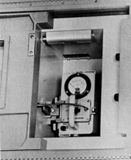
survey meters and dosimeters. We are today the only non-government lab in the nation that specializes in calibrating all these high-range radiation detector Civil Defense instruments. We do so with the CD V-794, N.I.S.T. Traceable Cs-137 (Cesium) calibrators pictured here...
Our full-time RSO (Radiation Safety Officer) and lab director here, has served as an RSO on three separate licenses. He began his career in the early 60's at Oak Ridge National Labs and subsequently served at both Los Alamos National Laboratory and PanTex Nuclear Weapons Plant facility, as well as numerous nuclear power plants. He was a consultant to the Safeguards Program focused on developing the anti-terrorism strategies for nuclear facilities in the US. He was also the Chairman of the Nuclear Technology Program at a southern university for seven years and is the author of five books on the subject. Also, while at the Texas Bureau of Radiation Control, he not only repaired, maintained and calibrated these same FEMA Civil Defense radiation detector instruments, but was a certified instructor in the proper use of them in a nuclear emergency.
Our goals and commitments in both processing, calibrating and distributing these instruments to emergency agencies and
the public are covered in greater detail below at the Q&A section entitled:
What's RadMeters4u.com Approach & Commitment?
A: The reasons for acquiring a radiation detecting survey meter, Geiger counter
and/or dosimeter are as varied as are peoples perceptions of the most likely threats. Radiation threats are unique in that you can't
see, smell, taste, hear or feel them, until it's already done its damage and you are
suffering the effects. Without a radiation
detector you would have to depend
solely on the limited resources of the authorities to monitor your location, then
determine your risk level, decide the best protective action and then to 'get the word out'.
Exclusively depending on others
to monitor, evaluate, warn and advise you, in a rapidly developing nuclear emergency crisis,
would surely not be anywhere near as quick or accurate in revealing your current risk as when you are
capable of taking your
own independent radiation readings. Also, where authorities are warning of radiation fallout not
yet arrived, but anticipated to be heading your way, with a radiation meter you'll be able to confirm that the
suggested protective
action is in fact reducing your exposure and not inadvertently increasing it. (Safe avenues of
evacuation and/or
designated safe areas can potentially shift as quickly as the wind!)
The specific causes of potential life-threatening nuclear radiation emergencies include...
Many find that improbable today, but the Russians apparently don't, as reported here on July 12, 2010: "Moscow arms against nuclear attack - Nearly 5,000 new emergency bomb shelters will be built in Moscow by 2012 to save people in case of potential attacks. Moscow authorities say the measure is urgent as the shelters currently available in the city can house no more that half of its population. In the last 20 years, the area of air-raid defense has been developed little, and the existing shelters have become outdated. Moreover, they are located mostly in the city center, which makes densely populated Moscow outskirts especially vulnerable in the event of a nuclear attack. In order to resolve the issue, the city has given architects a task to construct a typical model of an easy-to-build shelter that will be located all over the city 10 to 15 meters underneath apartment blocks, shopping centers, sport complexes and parks, as in case of attack people will need to reach the shelters within a minute."
Which parts of the shelter give the best protection?
How large is the radiation dose being received by each person?
When is it safe to leave the shelter for a few minutes?
When can one leave for an hour's walk to get desperately
needed water? As the fallout continues to decay, how long
can one safely work each day outside the shelter? When can
the shelter be left for good? Only an accurate, dependable
fallout meter will enable survivors to answer these
life-or-death questions.
With a reliable dose rate meter you can quite quickly determine
how great the radiation dangers are in different places, and then
promptly act to reduce your exposure to these unseen, unfelt dangers.
For example, if you go outside an excellent fallout shelter and learn
by reading your dose rate meter that you are being exposed to 30 R/hr,
you know that if you stay there for one hour you will receive
a dose of 30 R. But if you go back inside your excellent shelter
after 2 minutes, then while outside you will have received a dose
of only 1 R.
In any future nuclear emergency, there will be many more people, both near and far, that are not in harms way, but won't know it without any radiation detection instruments. They will worry needlessly or, possibly, even panic. Others, who should promptly get to a safer area, won't know to do so either, or if they do go someplace else, won't be able to confirm that it is indeed safer, without such specialized devices. The key to assuring your family is safe, or have gotten safer, or even if any should later seek medical attention, or not, is only possible if you have your own radiation detection instruments, with you, right then. With them in-hand, in a for-real future nuclear emergency, it's like being the only one then with a flashlight in a blackout to promptly, and confidently, lead the safest way out!
Bottom Line: Having on-hand an inexpensive radiation detecting meter in this day and
age is cheap
family insurance and, like major medical insurance, we can also hope & pray never to have to use it!
Also, like any real insurance, it'll be near impossible to get one after something has happened!
A: Everything in nature would prefer to be in a relaxed, or stable state. Unstable
atoms undergo nuclear processes that cause them to become more stable. One such process
involves emitting excess energy from the nucleus. This process is called radioactivity or
radioactive decay. "Radiation" and "radioactivity" are often confused, the proper relationship
is that "radioactive atoms emit radiation." The three main types of nuclear radiation emitted
from radioactive atoms are:
A: Since nuclear radiation affects people, we must be able to measure its presence.
We also need to relate the amount of radiation received by the body to its physiological
effects. Two terms used to relate the amount of radiation received by the body are
exposure and dose. When you are exposed to radiation, your body absorbs a dose
of radiation.
As in most measurement quantities, certain units are used to properly express the
measurement. For radiation measurements they are...
Other measurement terms: Standard International (SI) units which may be used in place of the
rem and the rad are the sievert (Sv) and the gray (Gy). These
units are related as follows: 1Sv = 100 rem, 1Gy = 100 rad. Two other terms which refer to the rate
of radioactive decay of a radioactive material are
curie (Ci) and becquerel (Bq).
Bottom Line: Fortunately, cutting through the above confusion, for purposes of
practical radiation protection in
humans, most experts agree (including FEMA Emergency Management Institute) that Roentgen,
Rad and Rem can all be considered
equivalent, especially in an emergency. The exposure rates you'll usually see will be expressed simply in terms of
roentgen (R) or
milliroentgen (mR). For details on how much is too much "R", see the Q&A
section below entitled: Which Survey Meter Would Be Best For My Needs?
Example of the relationship between a survey meter and a dosimeter; Bottom Line: Both meters and dosimeters have their place, and their limitations, in indicating the presence of hazardous radiation levels, and when utilized by a person with the basic understanding of what they are each measuring, they can be critical life-saving tools to survival in a nuclear emergency.
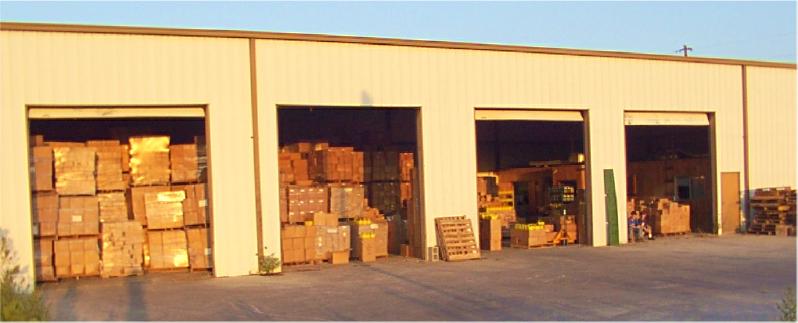
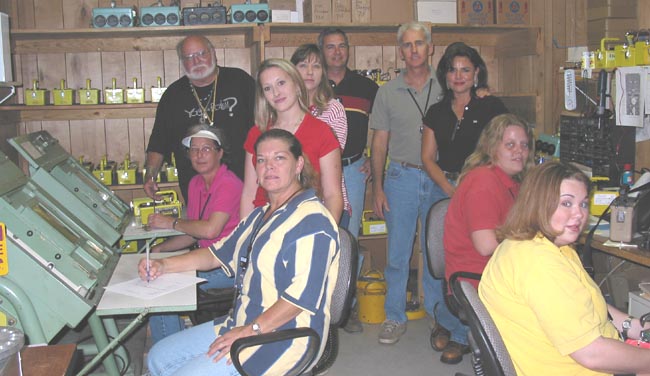
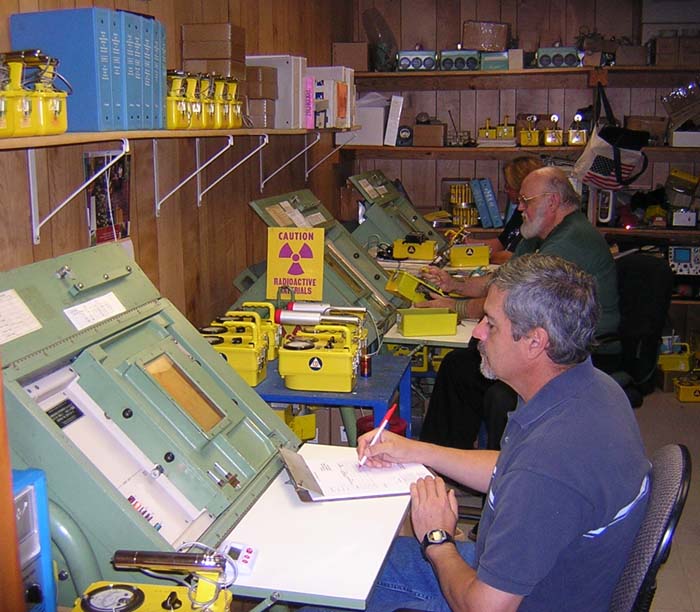
Q: How Good Are Surplus For Sale FEMA Civil Defense Radiation Detector Survey Meters, Geiger Counters and Dosimeters?A: From the numerous FEMA technicians who have maintained, repaired and calibrated thousands of these Civil Defense Radiation Detector Survey Meters, Geiger Counters and Dosimeters over many years, oftentimes even decades, we heard nothing but praise with a few specific maintenance cautions to be aware of. Most of these technicians have seen the same units come back in from active use in the field for their 1, 2 or 3 year re-calibration certification. (The calibration schedule varies based on the particular application they might be utilized for 'in the field'.) They know first-hand how well they hold up their calibration and can be counted on to perform. (Many tens of thousands of these same exact type Civil Defense radiation survey meters and dosimeters are also currently deployed in various states and amongst hundreds of their local governments First-Responders; the fire, police, EMT, and HazMat teams. I was also notified that a fair number of hospitals also utilize them to periodically check their X-Ray machines, etc. for leaks, too.) All the technicians variously described the properly maintained, calibrated, and stored Civil Defense radiation detector survey meter and dosimeter as "accurate", "reliable" and "dependable". Many of these same technicians and radiological officers are also atop the call lists in their respective states for any radiological emergency and many of these same radiation detector survey meters and dosimeters are what they will be confidently responding with. They know them well and trust them. However, surplus or auction acquired Civil Defense radiation detector meters and dosimeters are often brought onto the market with little or none of their previous history known of their maintenance, repairs, last calibrations, and past storage conditions. Many of these units, unlike the reliability proven units described above and maintained on a regular basis, may have been out of that maintenance 'loop' for as long as 20 years or more. Or, they may be new-in-the-box units, produced in the 60's or 70's, that never even got into the maintenance 'loop'. The functionality, reliability and accuracy of any particular individual surplus Civil Defense meter or dosimeter can not be assumed, until actually verified and proven to be so. We know this from the experience of culling out the bad units from amongst the good as we've evaluated, tested, and had calibrations attempted on literally tens of thousands of these same surplus radiation detector meters and dosimeters since early summer of 2001. (We have well over 100,000 of them here in our facility. See photos of our warehouse and lab below.) Many of these surplus meters can be every bit as reliable and accurate as those described above, but it first requires a systematic evaluation and testing process to identify them. More on that essential process is covered below in the Q&A section entitled: "Where Can You Buy a Quality Civil Defense Survey Meter?" and at "What's RadMeters4u.com Approach & Commitment?" Bottom Line: We found the above positive sentiments by FEMA technicians so universal, and witnessed the successful tests and calibrations of enough regularly maintained meters, that we are confident that a properly maintained, calibrated, and stored Civil Defense radiation detector Survey Meter or dosimeter will give its owner very reliable and accurate service. The goal then needs to be to assure that you acquire only a quality Civil Defense meter or dosimeter that is first proven to be fully up to these maintenance, calibration and storage standards.
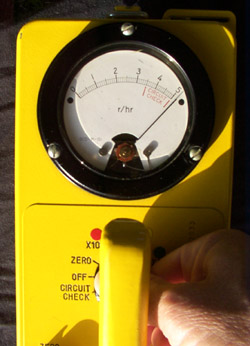
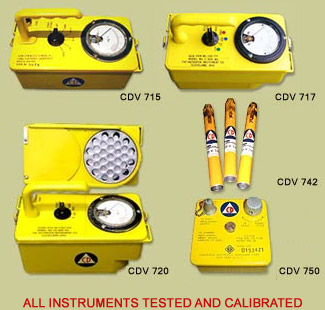
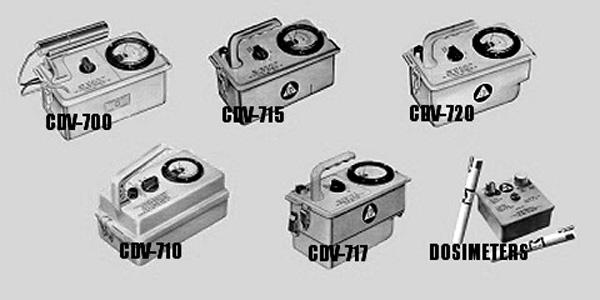
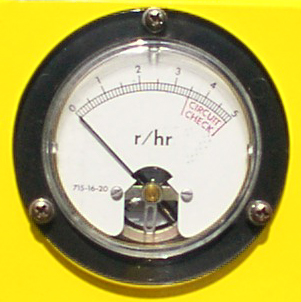
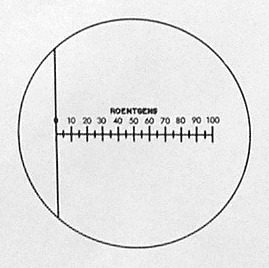
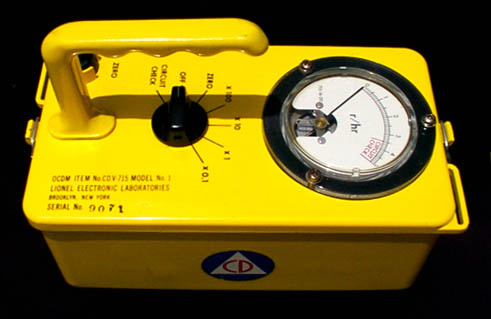
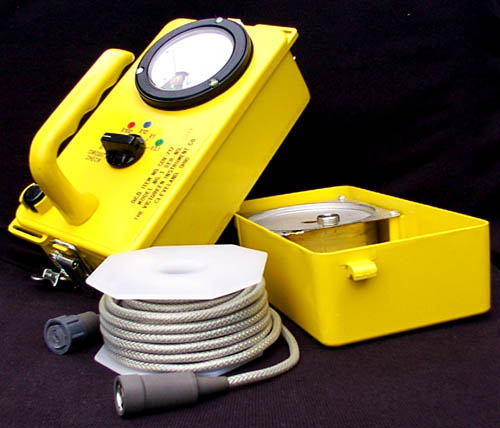
Q: What Are the Different Types of Radiation Detection Civil Defense Survey Meters?A: Amongst the Civil Defense Radiation Detection Survey Meters there are four primary types, one low-range meter and three high-range meters. (There was one other high-range meter, the plastic encased CD V-710, that we don't see much of anymore, was dropped by FEMA early on, and will not be including it here.) The following three survey meters are the most common Civil Defense high-range meters. The detector on all these high-range survey meters is an ionization chamber. It measures gamma radiation. The R/hr in the ranges indicated below refers to Roentgen per hour exposure rate. They each have a 1-5 numbered meter range and four multiplier scales: X100, X10, X1 and X0.1, with the exception of the CD V-720, that does not have the X0.1 scale. The CD V-715 and CD V-717 with the multiplier scale, X0.1, provides that the 0 - 5 range would be read as 0 - .5 R/hr when it's selected. The other differences between the three radiation detection units is that the CD V-717 includes a 25' cable for remote sensing and the CD V-720 employs a sliding beta shield on the bottom to allow for beta radiation detection, too. However, the CD V-720 has some reliability issues and while we will still calibrate a customers meter, we do not sell them here. FEMA generic basic operating instructions for high-range meters and dosimeters is here.
The low-range Civil Defense Geiger counter is the CD V-700 below...
The detector on the CD V-700 is a Geiger-Mueller (GM) tube. It measures gamma radiation. It has a check source on the side and a headphone jack. The range selector switch allows you to measure up to 50 mR/hr. A milliroentgen (mR) is one thousandth of a Roentgen (R). The probe on the CD V-700 has a section in the center which rotates to expose a window for also detecting beta. When the window is open it detects both beta and gamma. This survey meter is calibrated only for gamma radiation, so you can not get an accurate reading of the exposure rate from beta particles, only an indication of their presence. The CD V-700 is a low-range meter more suited for peacetime use than the above three high-range CDV-715's, 717's and 720's. According to the 1993 FEMA publication #SM 320 "Fundamentals Course for Radiological Monitors" states: "It is only able to measure up to 50 mR/hr and unit may become "saturated" in a higher field of radiation and act erratically, even to the point of giving false low readings in radiation fields exceeding 1000 mR/hr (1 R/hr)." However, it is very well suited for verifying successful decontamination and/or checking for low-level contamination in food or water. But, as you'll see in the following section, detailing the most dangerous levels of radiation to be most concerned about, if you can only initially afford one meter, it needs to be a high-range meter first. We have a separate page offering calibrated low-level CD V-700 Geiger Counters at http://www.radmeters4u.com/more.htm | ||||||||||||||||
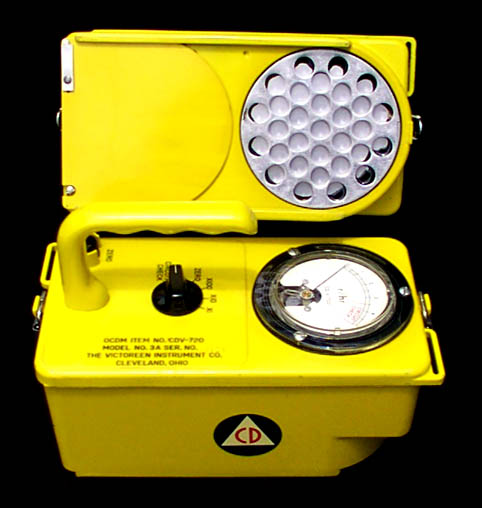
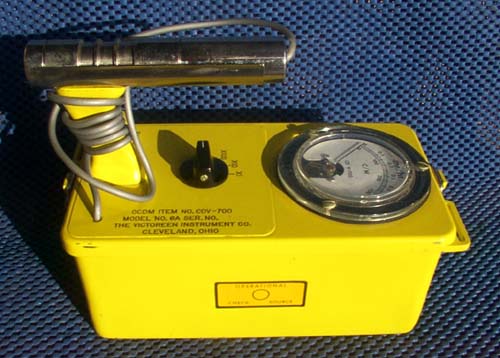
|
A: The first decision in selecting a radiation detector survey meter is
choosing whether a high-range meter or a low-range meter would best suit your goals and needs.
A survey meter will be used to help make critical decisions, such as to flee, how far, and to
where. Or, to stay in-place, and if staying then in determining the best protected location in your home or
shelter. Then, later, for determining when it is safe again and until then, when and for
how long someone could briefly exit the protected area to perform a critical chore, etc.
Key to that high or low range decision should
be to first understand and then determine the levels of radiation exposure
one should be
most concerned about
in a nuclear emergency. Then the correct range radiation detector meter best suited for the job will be readily obvious.
The following is compiled from FM 3-7. NBC Field Handbook, 1994. FM 8-9. NATO Handbook on
the Medical Aspects of NBC Defensive Operations, 1996. FM 8-10-7. Health Services Support in a
Nuclear, Biological, and Chemical Environment, 1996.
It is instructive in outlining the levels of radiation and
their health effects.
It should be readily apparent now that the more dangerous levels of radiation are well beyond the capability of a low-range radiation detector survey meter, such as the CD V-700, which would be maxed out at 50 mR/hr which is only .05 R/hr. (A low-range meter is better suited for verifying successful decontamination and/or checking for low-level contamination in food or water.) With that meter alone, and maxed out, you would not know if you just walked into a 1 R/hr field or a potentially fatal 500+ R/hr environment. Cresson H. Kearny, covers this point, too, in his book Nuclear War Survival Skills, Chapter 10 - Fallout Radiation Meters: Instruments that measure only milliroentgen-range dose rates are sold for war use by some companies. Since most Americans have no idea what size of radiation doses would incapacitate or kill them, and do not even know that a milliroentgen is 1/1000 of a roentgen, some people buy instruments that are capable of measuring maximum dose rates of only one roentgen or less per hour. The highest dose rate that it can measure, one roentgen per hour, is far too low to be of much use in a nuclear war. Bottom Line: Low-range and sensitive Geiger counters, like the CD V-700, do have their place, and we offer them here, but without a higher-range radiation detector survey meter first, and initially, warning you away from exposure to excessively high levels of lethal radiation, the opportunity to later even use a low-range radiation detector meter may never come! OK, so if it's a high-range survey meter we would need first, then which Civil Defense high-range survey meter is 'the best'? We asked this and other important related questions in all of our conversations with the FEMA technicians and radiological officers we interviewed. They responded; #1 - Any of the high-range radiation detection Civil Defense meters will work just fine IF it has been properly maintained, stored, and calibrated. Also, calibration no more frequently than every 4-6 years is normally sufficient IF shelf-bound and stored properly, but is much more frequently required if subjected to rough handling, for example, bouncing around in the trunk of a car. Also, they emphasized that the calibration needs to always be with a sufficiently strong enough radioactive source that a mid-scale meter reading can be attained for all the ranges, not just the lower ranges. #2 - Universally, when pushed to rank them, most all of them said their preference for a particular CD survey meter model was in the following order: CD V-715, CD V-717, CD V-720. Asked to elaborate why this personal preference and most said it was for the lighter weight of the CD V-715 over the other two and the basic KISS principle in that the CD V-715 had no frill 'bells & whistles' that might invite complications in the field. Also, many were openly critical of the CD V-720 design 'feature' of its sliding beta shield for attaining beta readings. They felt it was more of a marketing 'feature' than of any real practical use. They also found it required more maintenance attention as it was more prone to allow the intrusion of humidity and dirt and/or contamination internally. We also inquired how comfortable they were with used and visibly worn Civil Defense survey meters compared to any of the same type new and largely unused meters available there on their shelves, too. They made it clear that it didn't matter, used or new looking, just so long as it was properly maintained, calibrated, and stored until needed. If called on to respond to a radiological emergency, they would rush out the door with whatever unit, new or used, was known to them to of been properly maintained, calibrated, and stored correctly there. |
|
Q: Where Can You Buy a Quality Radiation Detection Civil Defense Survey Meter?A: Civil Defense radiation detection survey meters used to come on the market via very infrequent, but sometimes very large, FEMA auctions ever since the Federal government, in the 1st Bush and then Clinton administration, de-funded the FEMA/state partnerships that had previously maintained our national nuclear Civil Defense program. Now most govt auctions are by states, rather than FEMA. They are most often bid on by surplus wholesalers, but sometimes by other unrelated businesses and even individuals hoping to turn them for a quick profit. They buy them by the pallet load lots, perhaps 40-80 pallets per lot and as many as a dozen lots or more in any one auction. But, of course, these auctions can be bigger or smaller, too. Once acquired they are then typically sold in smaller lots to other wholesalers and any business that might have a potential customer base interested in them retail, such as Army/Navy surplus stores, preparedness companies and internet based companies catering to the same type clientele. You can check any of the above, or search the internet ('Geiger counter' is a good search term), and you'll always find some offered at www.ebay.com. (Here at KI4U we offer only calibrated Civil Defense meters. See What's RadMeters4u.com Approach & Commitment? below after carefully studying the following information.) Most all these potential outlets are interested in moving them out with as little additional input (time/money/energy) as is possible. While that's understandable business-wise, you'll need to be aware of what these meters are, and are not, likely capable of when you consider getting yours, especially when they tell you that "it works", and that's what you are relying upon. As of August, 2010 we've successfully calibrated and certified literally over 25,000 of the 100,000+ Civil Defense meters and dosimeters we'd acquired from the Federal Depot in 2001, along with countless hundreds more from state and municipal agencies and individuals who have sent theirs into us for calibration. We are the only private calibration lab in the country that specializes in re-certifying and calibrating all the Civil Defense meters and dosimeters. What we've learned is priceless, and should be well understood by anybody considering buying even just one radiation detector unit as a serious nuclear radiation detection instrument. (Of course, if you are only wanting one as a 'cold war relic' conversational piece for the mantle, or as a doorstop, you can disregard the following and simply shop for the cheapest and neatest looking available.)
What this all means to you in selecting and acquiring a Civil Defense radiation detector survey meter is that when the seller says simply "It works." or "It passed the circuit check test.", they likely have only dropped a couple batteries in it and performed the 'circuit check' to arrive at those conclusions. And, it's 35/65, those meters might not be functioning sufficiently enough for them to even be later calibrated... without repair work first. And, even less likely that you'd be getting a functioning meter whose last calibration, who knows when, was still holding accurately enough that you didn't need to have the calibration re-done again. (Also, you won't know how well its been handled or stored since that last calibration either.) And, you will never know, unless and until you then get it re-calibrated yourself. Bottom Line: If you want/need a radiation detector meter you can have complete confidence in that it will perform reliably and accurately when it'll count the most, then you've either got to... Acquire a meter that was recently successfully calibrated (See What's RadMeters4u.com
Approach & Commitment?) A: Our approach and commitment here is identical to that we've held
at our
Potassium Iodide Anti-Radiation Pill FAQ
at ki4u.com since 1999, where we strive to provide both the best current information and products, and
at prices
to where more families can then get prepared, both correctly and confidently.
We have, and will continue to, invest the time, money, and
energy to assure the best sources of radiation protection information and products at affordable prices for families
wanting to acquire these essential Civil Defense radiation detection survey meters and dosimeters.
To this end we had acquired in the Spring of 2001 the above mentioned 100,000+ items of FEMA
Civil Defense survey meters, Geiger counters, dosimeters, chargers and test equipment. (And, hired qualified
FEMA trained technicians!) A total of 416 pallet
loads were trucked in from the Federal Depot in Fort Worth to our 5,200 square foot warehouse here in Gonzales,
Texas.
All of our personnel have successfully completed both the General Employee Radiological Training and the Radiation Worker Training courses, as well as specialized training on the calibration equipment. Carl Kee, our full-time RSO (Radiation Safety Officer) and lab director here, has served as an RSO on three separate licenses. He began his career in the early 60's at Oak Ridge National Labs and subsequently served at both Los Alamos National Laboratory and PanTex Nuclear Weapons Plant facility, as well as numerous nuclear power plants. He was a consultant to the Safeguards Program focused on developing the anti-terrorism strategies for nuclear facilities in the US. He was also the Chairman of the Nuclear Technology Program at a southern university for seven years and is the author of five books on the subject. Also, while at the Texas Bureau of Radiation Control, he not only repaired, maintained and calibrated these same FEMA Civil Defense instruments, but was a certified instructor in the proper use of them in a nuclear emergency. All of the Civil Defense radiation detector meters in our lab are taken through the following preventative maintenance, tests, and evaluations prior to calibration:
All calibration certifications of these Civil Defense survey meters is accomplished here with the CD V-794 calibrators built specifically for these type meters. This calibrator utilizes a N.I.S.T. traceable Cs-137 source that tests and calibrates (adjusts) mid-scale for all the ranges strictly in accordance with industry standards. KI4U, Inc. is licensed and authorized by the State of Texas to perform these calibrations at our lab here conforming to the standards as set forth by the State of Texas, FEMA, ASTM and the NRC.
After successfully calibrating the unit on all scales, they are then certified fully ready for reliable, accurate and confident service in the field. Successfully calibrated instruments are returned with the label below affixed to them certifying their calibration and stating who calibrated it and when, along with the serial number and model designation. Additionally, a Certificate of Calibration with the actual before and after accuracy responses for each of the different ranges available on the instrument is included. 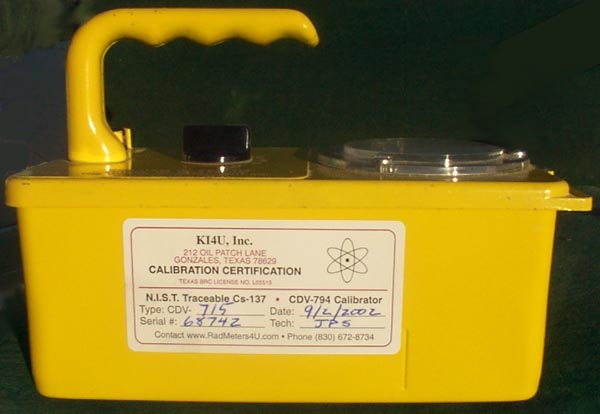
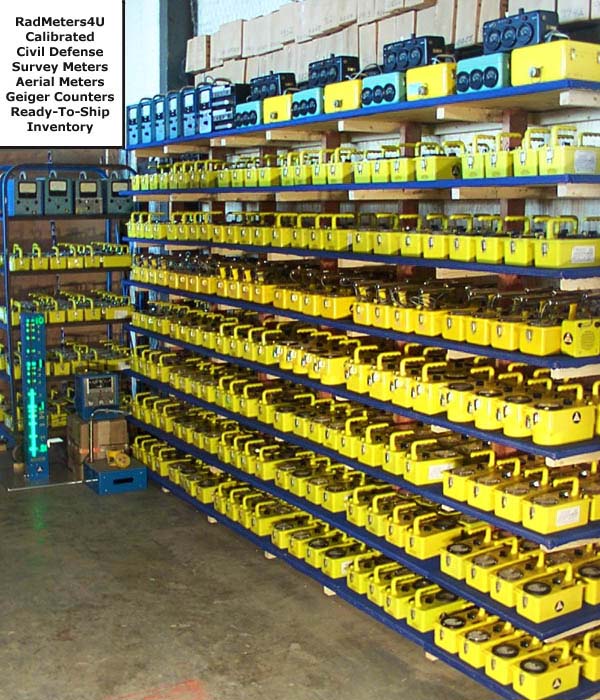
And, they are available for a fraction of the cost of a new high-range survey meter today that would cost you $1,000.00+! The delivered prices within the USA for our calibrated Civil Defense survey meters can be seen here!
Q: What about Dosimeters and Chargers?A: Dosimeters and their required Chargers should be readily seen as an important additional asset by anyone that already understands the need for a survey meter. 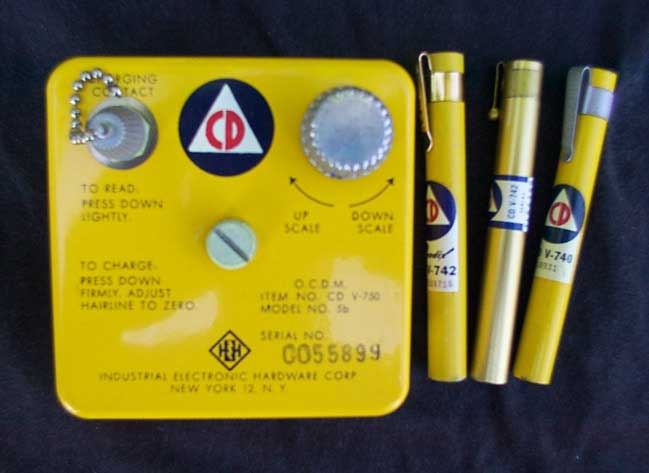
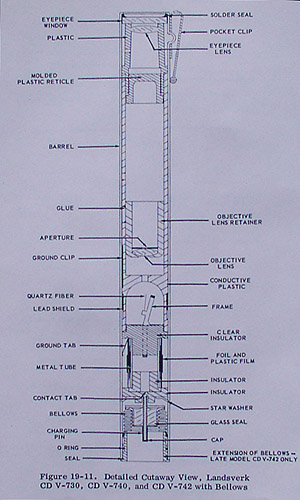
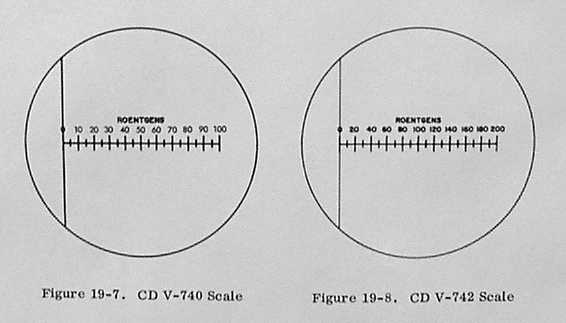
The "Operating and Maintenance Instructions", that come with each CD V-750/756 charger, explains how to zero your dosimeter with the charger. However, something we hadn't seen addressed in them, is that the fiber image may shift slightly when the dosimeter is removed from the charger. This hairline "kick" is a common occurrence, particularly on the lower-range dosimeters. Simply repeat the charging procedure until a zero reading is obtained. If this is difficult, a poor ground condition at the charging pedestal is likely. This condition may be more pronounced if the charger has not been used for a period of time. Dosimeters can be defective, too, like any instrument. Electrical leakage in dosimeters creates movement or drift of the fiber from an initial setting OR towards an up-scale reading without the presence of radiation. There can be half-a-dozen reasons why, but typically it is caused by contaminates in the manufacturing process, outgassing of internal components, such as plastics, or broken hermetic seals allowing humidity intrusion. FEMA current requirements for field dosimeters is for electrical leakage to not exceed 5% of full scale for a 50 degree C five day test. (Maximum leakage limit is 1% of full scale per day.) The test procedure requirements are quite a bit more involved than just slow cooking them for five days, but that's the primary objective to encourage failure in any units prone to these problems. Any dosimeters failing to meet this standard are considered defective and should be repaired. Dosimeters need to also then be tested for accuracy by being exposed to a known radiation source that should hit mid-scale on their particular range. (Dosimeters are not completely linear and the only provided calibration points are always mid-scale.) FEMA specifications require that dosimeters should respond to within plus or minus 10% of true dose. But, because the calibrator 'box' geometry (positioning) and radiation scatter components makes absolute calibration impossible, they allow a deviation as great as 15%. Also, as an expediency, because they recognize that even dosimeters that are off by plus or minus 25% still provide valuable information, they also permit a label denoting a correction factor, but you need to keep in mind that dosimeters are not perfectly linear. The prescribed procedure for radiation exposure testing of dosimeters is much more involved than calibrating a survey meter, both time-wise and in required operator participation setting it up and monitoring it throughout its duration. We utilize a specially designed rotating carousel within the CD V-794 calibrator as specified by FEMA to achieve the correct and uniform mid-scale radiation exposure for this test. If any are then found to not pass that radiation exposure test they can't then be easily calibrated (adjusted) or fixed. (It can be done with the right equipment, it's just a very involved chore.) Agencies normally just relegate them to a 'do it sometime much later' repair box or auction them off to unsuspecting bidders. (We recently passed on an offer of 30,000 dosimeters that with some diligent digging were eventually discovered to have been the collected defective rejects of a state agency that had tested 100,000 in-house over a number of years.) However, those that do pass the electrical leakage test and also the radiation exposure accuracy test, should be held in high confidence of performing accurately and reliably in the field. (BTW, of dosimeters that we've performed the electrical leakage test on, that have passed that test, we've found a 93% success rate amongst them later for the radiation exposure accuracy test.) The logic of preferring a high-range dosimeter rather than a low-range dosimeter is the same as for survey meters. We offer one model of high-range dosimeter (CD V-742) and they will all have been both successfully electrical leakage tested AND radiation exposure accuracy tested. They will have a certification sticker indicating such on them. Any dosimeters here that fail either test are put aside for possible future repairs, if/when we expand into that service. The delivered prices for each dosimeter, and for dosimeter chargers can be seen here!
Q: I Already Have a Radiation Detection Survey Meter or Dosimeter, Can You Calibrate It?A: We get a lot of inquiries from those who already have one or more survey meters or dosimeters needing calibration. Also, many State and municipal emergency response agencies have contacted us to re-calibrate and certify their current in-service radiological instruments. (FEMA sets 4-6 years as a maximum span between calibrations if the meter had always been shelf-bound, however if you know, or don't know if, your meter had been exposed to any rough handling, then sooner may be prudent. Regardless, most agencies mandate minimum 1 year re-certification schedules, and nuke plants require every six months.) We can calibrate any of the CDV series radiation detectors survey meters and dosimeters and many other brands, as well. KI4U, Inc. is licensed and authorized by the State of Texas to perform these calibrations at our lab conforming to the standards as set forth by the State of Texas, FEMA, ASTM and the NRC. Complete details on having your Civil Defense radiation detection survey meters, dosimeters, or any type radiation detector calibrated are here. FYI, if somehow you are ever stuck with an un-calibrated radiation detector meter in a future nuclear emergency you might could find some use for it if a known calibrated meter is also handy. If/when the time comes and you find yourself in an actual radiation field, you could use it (the calibrated meter) to also test against your other (un-calibrated) meters reliability and accuracy. If one of your current, un-calibrated, meters reads high or low compared to the calibrated meter, then you could mark on it a correction factor denoting that meters particular variance from a true reading. This would allow you to then get some useful service out of it while keeping the correction factor in mind. That's a much better use of any un-calibrated instruments, rather than having them sit on a shelf unused in an ongoing nuclear emergency or selling or giving them to somebody else that doesn't know how important it is to only rely on a recently calibrated meter for protecting their own family.
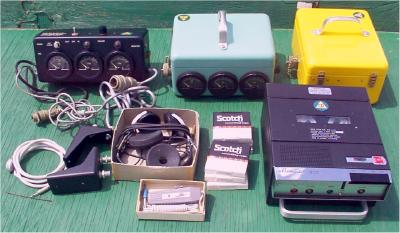
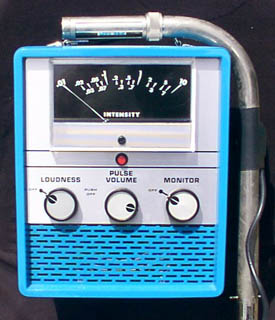
Q: What other type radiation detectors, meters, Civil Defense or not, are available?And, what other instruction in CD instruments is available? A: We have some other small quantities of calibrated Civil Defense low-range CD V-700's, and a few 'exotics', available that you can see here at http://www.radmeters4u.com/more.htm. There you'll see rugged 3-meters-in-one Aerial Fallout systems for use in airplanes to detect and map radioactive fallout. (Which work just fine for gamma detection here on the ground, too.) Also, Civil Defense fallout radiation barrier demonstration units that can be utilized by educational facilities or their detectors/meters possibly incorporated into a remote monitoring station. We also have some bench top G-M tube lab meters (CD V-457) and a limited number of 'enhanced' CD V-700's, as well as the external speakers (CD V-705's) and large probe housings for them, too. Details, pricing and ordering information for them all will be seen there at that page linked above. FINALLY: It's also vitally essential to learn how to properly use your CD instrument to then appreciate what they can reveal to you. The best reference is the FEMA 'RADIATION SAFETY IN SHELTERS' 120 page handbook. It is the premier instructional resource for the practical field use of these specific Civil Defense instruments calibrated here and sold on our site, in a for-real nuclear emergency. Subtitled: "A handbook for finding and providing the best protection in shelters with the use of instruments for detecting nuclear radiation." This practical manual goes far beyond the limited coverage included in the brief manuals that come with the FEMA Civil Defense survey meters and dosimeters. This is a must-have for anyone with CD instruments. Buy a hard copy to store with your meter and/or read it on-line for free here.

Also, see our popular 'The Package' where you get all our most popular products at over a 25% discount!!

Be Sure to Also Check Out Our...
Comments or Suggestions for additional resources to add here:
KI4U, Inc.
© www.NukAlert.com 2003, 2004, 2005, 2006, 2007, 2008, 2009, 2010, 2011, 2012, 2013, 2014. All Rights Reserved. | ||||||||||||||||